13 Tips for Mealtime Supports
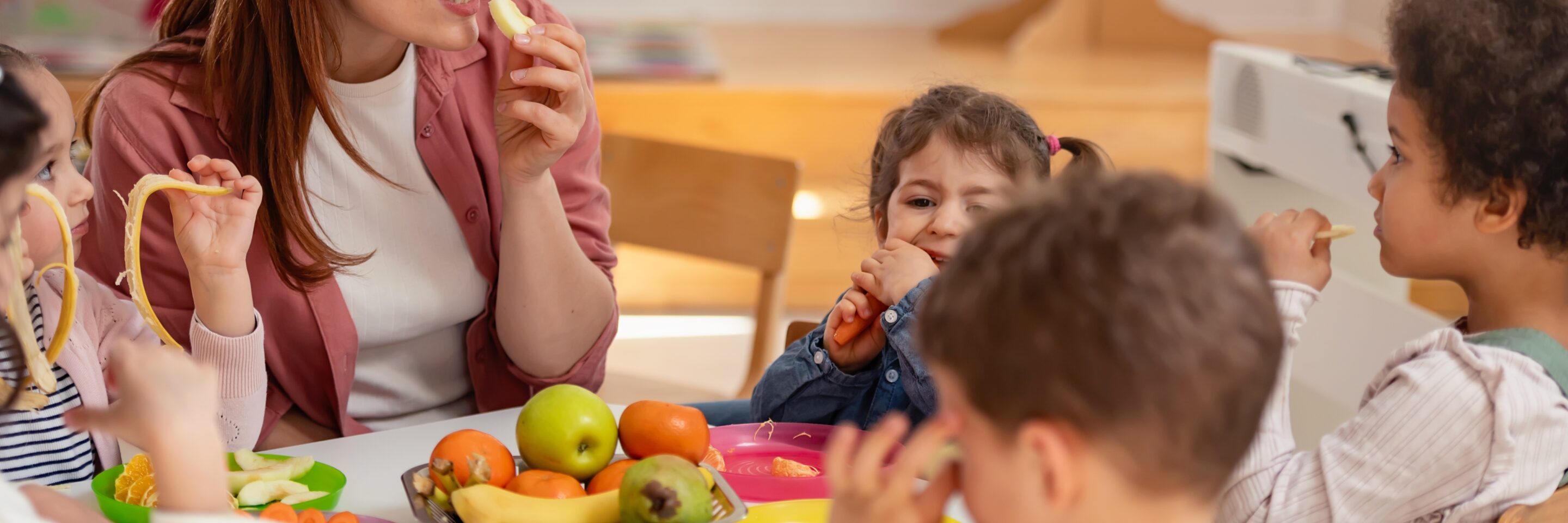
PublishedMealtime and snacktime can provide opportunities to help children build a variety of skills and strengthen adult–child and peer relationships. Through frequent repetition and growth, children can acquire complex adaptive, social-communication, and fine motor skills during mealtime routines.
Some young children may need extra help with aspects of mealtime and snacktime. Support strategies can include a variety of adaptations or modifications to daily routines, activities, and environments to meet targeted outcomes at home and in classrooms. Use these tips from Volume 4 of the AEPS®-3 Curriculum—Growing to support children during meals.
- Pay attention to children’s cues for when they are getting hungry, and make sure mealtime occurs before they get too sleepy to participate.
- Give children plenty of alerts about transitions to mealtime, especially if they are engaged in an activity that is difficult for them to leave.
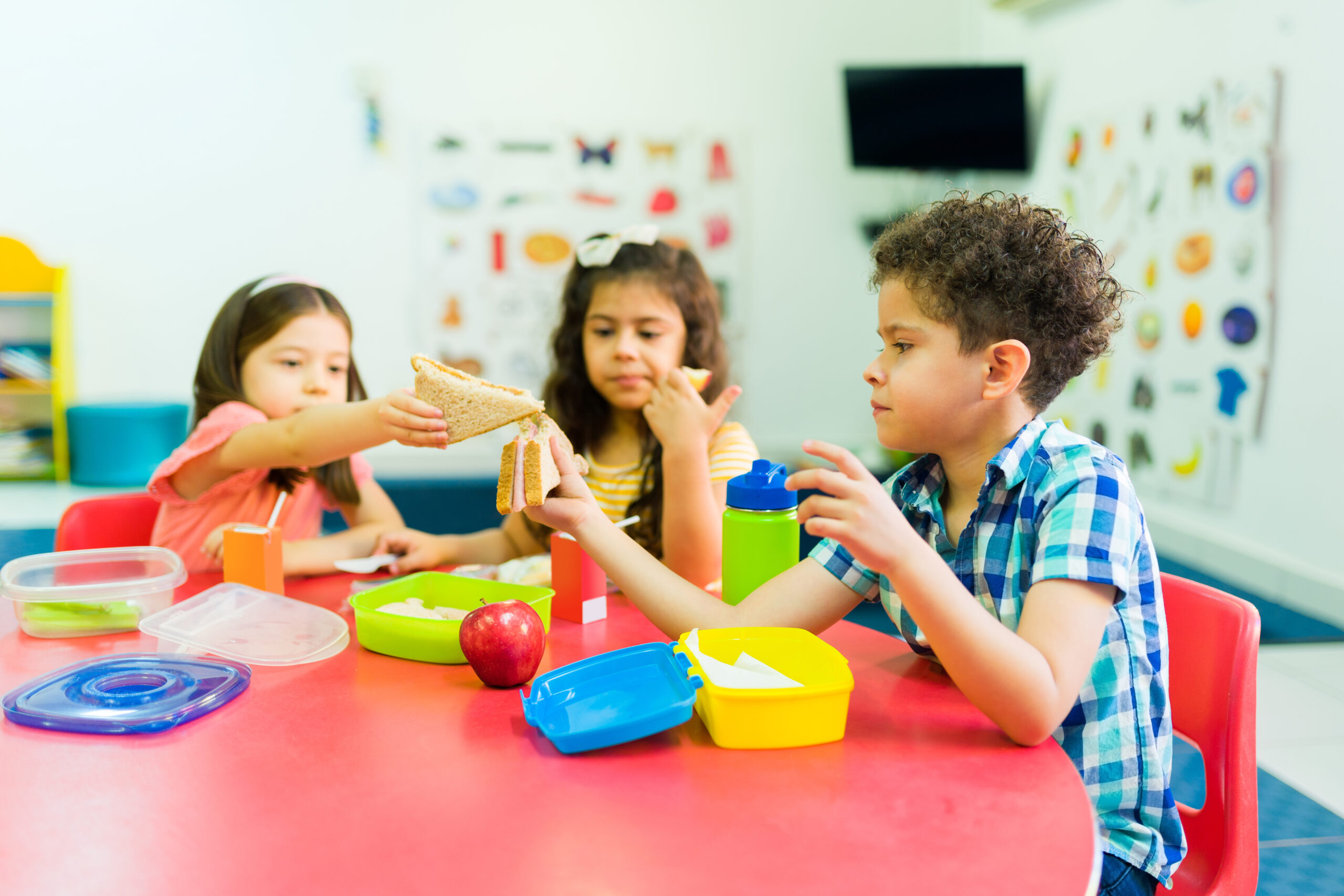
- Assign table buddies by pairing children who have slightly more advanced mealtime skills and more varied food preferences with children who are more cautious and have less advanced skills.
- Thin or thicken new foods to encourage young children who are sensitive to new textures to try them.
- Remove children who become distressed at the table for a minute or two to let them calm down, and reseat them afterward if they want to come back to the table.
- Position children for comfort and stability during mealtimes. Seat a young child who is learning independent eating skills in a child-size chair or highchair if possible. Provide seating with foot and arm support and a comfortable seat with a back, so the child can focus on eating rather than maintaining their sitting posture. (For children who have more intensive positioning and mobility needs, ensure seating that offers a secure base as well as arm and wrist fixation, such as an adaptive chair with seat belt, tray, or cushions that can be repositioned to meet the child’s needs.)
- For children who struggle with participating in family or classroom mealtimes, encourage practice with the social routines and expectations of mealtime by providing a pretend food or kitchen set to play with.
- Teach the child to use culturally accepted table manners and language they may need to be successful at the table.
- Address concerns about extreme eating habits and resistance to change by having a specialist do an oral-motor examination to rule out physical causes for eating issues.
- Teach children who cannot speak to use simple signs (more, all done) so they can communicate their preferences.
- Learn to recognize children’s cues and preferences. Pair sign language with spoken words for children who are nonverbal or who have hearing impairments.
- For children who are picky eaters, start with foods the child likes or tolerates, and introduce new foods gradually. A picky eater may have a sensitive gag reflex, sensitive taste buds, or increased sensitivity to smells. Keep a food journal) to see if any patterns emerge, and keep close track of food consistencies, tastes, and textures the child will eat. Offer small amounts of new foods many times.
- For children who need intensive physical support during mealtime, provide hand-over-hand graduated guidance (physical prompts) for skills that children find difficult (bringing one hand to the mouth to eat, scooping food from a bowl, drinking from a cup). As the child begins to perform the specific skill or step with full support, fade help gradually from hands, to wrists, to elbows.
NOTE: If mealtimes are especially challenging in your program, you may want to check out the book Meaningful Mealtimes, a unique user-friendly planning guide for early childhood educators and care providers. You’ll find lots of how-to guidance, helpful examples, and practical tools for making mealtimes a rich, engaging, and inclusive experience for all young children.
This post was adapted from Grisham, J., & Slentz, K. (Eds.). (2022). AEPS®-3 Volume 4: Curriculum—Growing. In D. Bricker, C. Dionne, J. Grisham, J. J. Johnson, M. Macy, K. Slentz, & M. Waddell, Assessment, Evaluation, and Programming System for Infants and Children, Third Edition (AEPS®-3). Brookes Publishing Co.