
8 Tips for Helping Kids Take Turns
PublishedTeaching young children critical skills like turn-taking will help them build friendships and positive social connections with their peers from an early age. Adapted from the new edition of the bestselling Beautiful Beginnings curriculum for birth to three, this article shares tips for helping young children learn to take turns with toys and other materials.
- If the child wants a toy that another child is playing with, teach them to ask, “Can I have it when you are done?” If the other child says “Yes,” then keep an eye on the situation and be certain the child receives the toy when the other child is finished. They may need to be supported in following through.
- Emphasize sharing when children are working on individual projects that involve shared materials. For example, when working with playdough, provide enough materials for every child to have one tool (e.g., a rolling pin, a cookie cutter, a plastic knife). Invite the children to exchange the tools.
- Model language such as “when finished,” “wait,” “next,” “done,” “your turn,” “their turn,” and “share.”
- When reading, stop to discuss what the characters are doing. If a character is taking turns, waiting, or exchanging, point that out.
- Using a visual timer such as a sand timer or app can help show the child how long they have to wait for their turn.
- Set up block play, making sure there is room for at least two children. If the children are building while engaged in parallel play, ask them if they can build a tower together by taking turns adding blocks to the tower. Encourage one child to offer pieces to the other child to put on the tower. Use a similar strategy in other play schemes that the children are interested in.
- It’s a good idea to have duplicates of the most popular toys rather than insisting that children always share.
- Many young children will need some ongoing adult support as they learn how to share. Continuing to model sharing and helping the child work through their complicated feelings around sharing will help the child succeed in the long run.
If you liked these ideas, invest in Beautiful Beginnings for 350+ more! This birth to three curriculum is full of joyful, engaging experiences that build on each child’s strengths and interests and encourage progress in areas of concern.
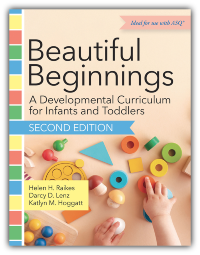
A Developmental Curriculum for Infants and Toddlers, Second Edition
By Helen H. Raikes, Ph.D., Darcy D. Lenz, M.Ed., & Katlyn M. Hoggatt, M.Ed.
Aligned with ASQ® and CDC developmental milestones, this extensive, research-supported curriculum includes 350+ easy-to-use activity sheets tailored for six different age ranges in the critical first years of life. Activities target eight key developmental areas important to school readiness: Communication, Gross Motor, Fine Motor, Intellectual, Discovery, Social-Emotional, Self-Help, and Pretend.